As few historians make any significant money on their writing, just knowing that people have read their books can mean a lot to an author. Here are some books released in 2025 by historians working off the tenure track that you might consider as you do your end-of-the-year shopping. (We are a Bookshop.org affiliate and purchasing through affiliate links helps support the magazine’s work.)
 Chance Bonar, The Author in Early Christian Literature (Cambridge University Press)
[Bonar] explores how early Christian writers began to care deeply about ‘correct’ attribution of both Christian and non-Christian literature for their own apologetic purposes, as well as how scholars have overlooked the function that orthonymity plays in some early Christian texts . . . urges us to examine forms of authorship that are often treated as an unexamined default, as well as to more robustly consider when, how, for whom, and for what purposes an instance of authorial attribution is deemed ‘correct.’
 Chance Bonar, God, Slavery, and Early Christianity: Divine Possession and Ethics in the Shepherd of Hermas (Cambridge University Press)
Ancient Christians understood themselves to be enslaved to God . . . This widespread belief is made especially clear in the Shepherd of Hermas, an overlooked early Christian text written by an enslaved person, which was nearly included in the New Testament . . . Bonar’s study clarifies the depth to which early Christians were entrenched . . . in Roman slave society. It also demonstrates how the Shepherd offers new approaches to early Christian literary and historical interpretation.
 Brian Bunk, Beyond the Field: How Soccer Built Community in the United States (University of Illinois Press)
Played by both migrants and native-born Americans, soccer created communities across the United States . . . Teammates and supporters shared meals, raised money for fallen players, and attended each other’s weddings and funerals . . . Bunk follows the story from the 1880s through World War I by profiling the struggles and joys of players while also tracing the overlooked impact of people of African, Chinese, Hawaiian, Jewish, and Filipino descent on American soccer culture.
 Sara Catterall, Amelia Bloomer: Journalist, Suffragist, Anti-fashion Icon (Belt Publishing)
Catterall follows the many chapters of [Bloomer’s] life: her humble upbringing in upstate New York, her role in the temperance movement (and its true legacy as a wellspring of the women’s rights movement), her years at The Lily, her groundbreaking position as deputy postmaster in Seneca falls, her troubled health, and her eventual move to Council Bluffs, Iowa, where she continued to move the needle on women’s suffrage in the more flexible new governments of the West.
 Jessie Wei-Hsuan Chen, Everlasting Flowers between the Pages: The Making of Seventeenth-Century Florilegia (Brill)
[Florilegia] were lavishly produced picture books that featured hand-drawn or printed illustrations of a wide variety of flowers . . . By approaching florilegia as material objects, [Chen] offers new insights into how florilegia mirrored different forms of plant knowledge. The volume reconstructs the expertise which gardeners, compilers of florilegia, and image-makers must have possessed in order to cultivate the once-living specimens and immortalise the flowers on paper and parchment.

Kimberly Chrisman-Campbell, Fashion Victims: Dress at the Court of Louis XVI and Marie-Antoinette (Yale University Press)
This award-winning book, now available in paperback, chronicles one of the most exciting, controversial, and extravagant periods in the history of fashion . . . Kimberly Chrisman-Campbell offers a carefully researched glimpse into the turbulent era’s sophisticated and largely female-dominated fashion industry, which produced courtly finery as well as promoted a thriving secondhand clothing market outside the royal circle.
 Surekha Davies, Humans: A Monstrous History (University of California Press)
[Davies] shows how monster-making is about control: it defines who gets to count as normal. In an age when corporations increasingly see people as obstacles to profits, this book traces the long, volatile history of monster-making and charts a better path for the future. The result is a profound, effervescent, empowering retelling of the history of the world for anyone who wants to reverse rising inequality and polarization. This is not a history of monsters, but a history through monsters.
 Barbara Di Gennaro Splendore, The State Drug: Theriac, Pharmacy, and Politics in Early Modern Italy (Harvard University Press)
From the 1490s, one of the most influential remedies to circulate in Europe was the “wonder drug” theriac . . . used to treat everything from venomous bites and poisons to headaches, sore throats, fevers, palsy, and heart problems. Examining this pivotal period in the history of medicine, [Splendore] shows how a panacea became a vehicle for political power as well as intellectual and commercial competition [and] sheds new light on the fraught, age-old intersection of power and pharmacy.
 Angela Roskop Erisman, The Wilderness Narratives in the Hebrew Bible: Religion, Politics, and Biblical Interpretation (Cambridge University Press)
Erisman offers a new way to think about the Pentateuch/Torah and its relationship to history . . . She explores creative transformations of genre and offers groundbreaking new readings of key episodes in the wilderness narratives . . . Erisman’s study draws from literary and historical criticism. Her synthesis of approaches enables us to situate the wilderness narratives historically . . .
 Jason Ezell, For a Spell: Sissie Collectivism & Radical Witchery in the Southeast, 1971-1981 (University of North Carolina Press)
In the Southeastern United States of the late 1970s, a regional network of radical communal gay households formed in the face of rising New Right terror . . . [spanning] from the Ozarks, to New Orleans, to Appalachian Tennessee. Jason Ezell’s intimate account of the formation and dissolution of these sissie houses reveals a little-known history of Southern gay liberation, nonbinary gender expression, and radical feminism and femininity.
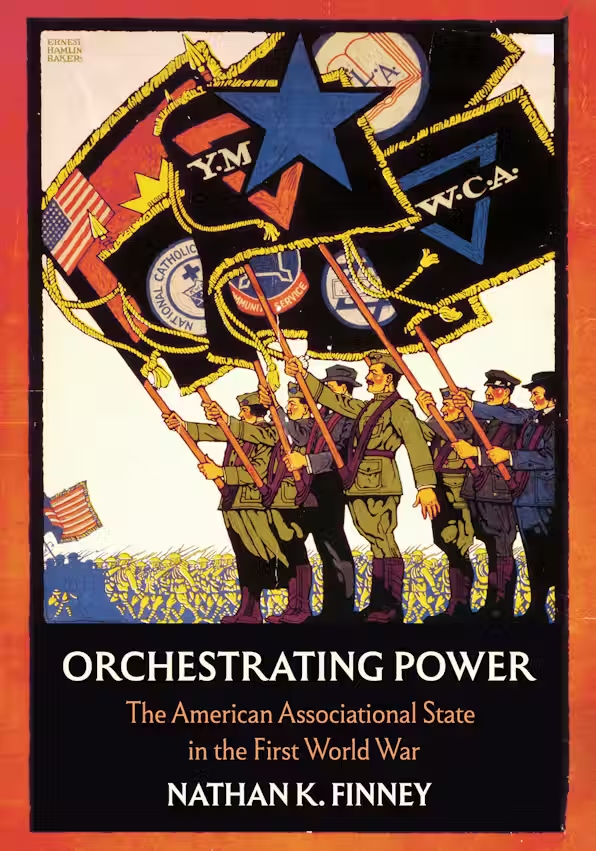 Nathan Finney, Orchestrating Power: The American Associational State in the First World War (Cornell University Press)
[Finney] explores how the expansion of the American state for the First World War reshaped the nature of governance . . . through the creation, structure, activities, and impact of the Council of Defense system on the ability of the United States to mobilize for a significant conflict in a foreign land . . . The result is a compelling story about how individuals drove dynamic and compelling regional and national events that propelled a massive national wartime mobilization.
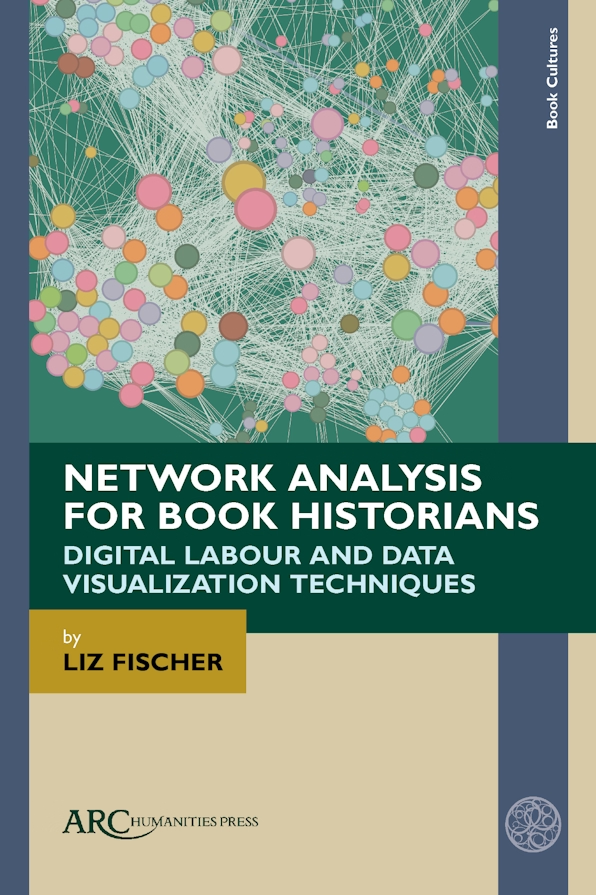 Liz Fischer, Network Analysis for Book Historians: Digital Labour and Data Visualization Techniques (Arc Humanities Press)
This book explores the potential of network analysis as a method for medieval and early modern book history. Presented through case studies of the Cotton Library, the Digital Index of Middle English Verse, and the Pforzheimer Collection, this book offers a blueprint for drawing on extant scholarly resources to visualize relationships between people, text, and books. [Fischer] gives a realistic look at the decision-making involved in digital humanities work . . .
 Robert Fitzgerald, Hardcore Punk in the Age of Reagan: The Lyrical Lashing of an American Presidency (University of North Carolina Press)
Few politicians produced the musical reaction that Ronald Reagan did. His California-branded conservatism inspired countless young people to pick up guitars and thrash out their political angst . . . Punk enthusiast Robert Fitzgerald argues that these songs’ lyrics aren’t just catchy and fun to scream along with; they also reveal the thoughts and feelings of artists reacting to their political environment in real, forthright, and uncensored time.
 Aaron G. Fountain, Jr., High School Students Unite!: Teen Activism, Education Reform, and FBI Surveillance in Postwar America (University of North Carolina Press)
Inspired by civil rights and antiwar movements, [high school] students across the nation demanded a voice in their education by organizing sit-ins, walkouts, and strikes . . . Fountain Jr. reveals how teenagers became powerful agents of change, advocating for constitutional rights and influencing school reform. Ironically, the modernization of school security . . . was partly a response to these student-led movements.
 Rhiannon Garth Jones, All Roads Lead to Rome (Aurum Press)
So, how many times a day do you think about the Roman Empire? The general consensus seems to be an awful lot, and All Roads Lead to Rome explains why . . . Jones embarks on a fascinating exploration of how the idea of Rome has been seized by emperors, modern governments, religious leaders and even pop-culture icons. Each chapter examines how Rome’s famous history, politics, and mythology have been reimagined through the centuries, and explores how these interpretations continue to shape our modern world.
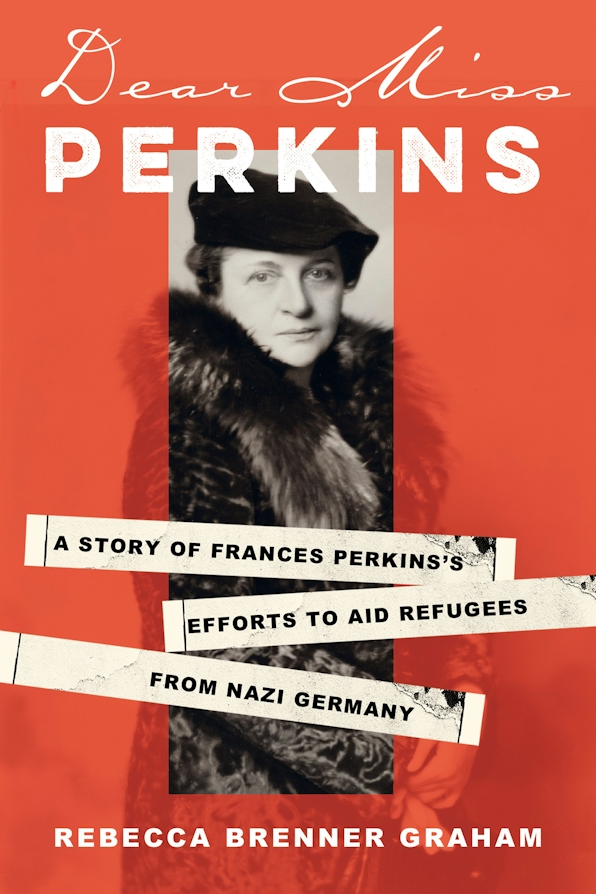 Rebecca Brenner Graham, Dear Miss Perkins: A Story of Frances Perkins’s Efforts to Aid Refugees from Nazi Germany (Kensington)
A fascinating portrait of the progressive female trailblazer and US Secretary for Labor who navigated the foreboding rise of Nazism in her battle to make America a safer place for refugees . . . Based on extensive research, including thousands of letters housed in the National Archives, Dear Miss Perkins adds new dimension to an already extraordinary life story, revealing at last how one woman tried to steer the nation to a better, more righteous course.
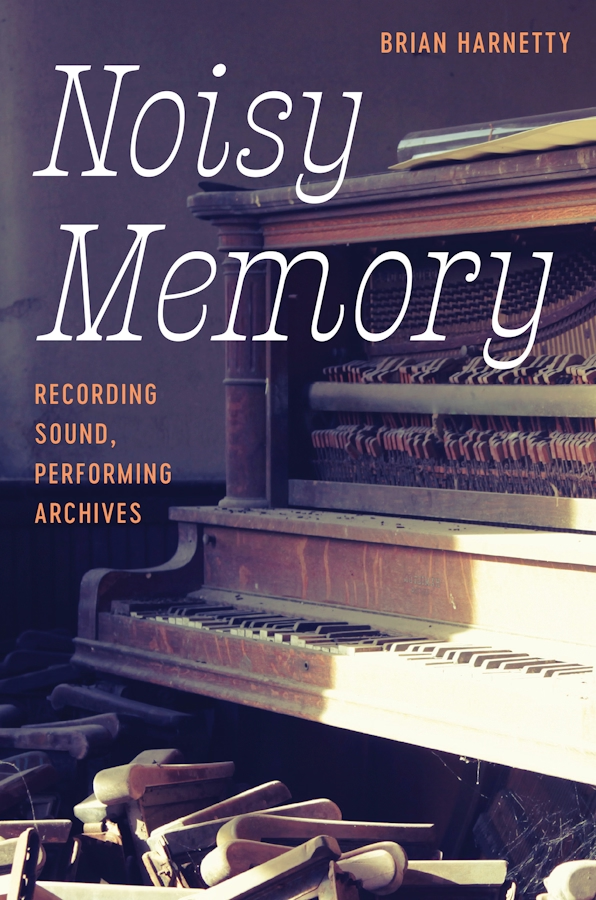 Brian Harnetty, Noisy Memory: Recording Sound, Performing Archives (University of North Carolina Press)
Composer and sound artist Brian Harnetty explores the remarkable everyday stories of sound recordings and shows us a new way to listen to the past. From murder ballads and oral histories in Appalachian Ohio, to the Afrofuturistic music of Sun Ra in Chicago, to the recorded thoughts of monk and writer Thomas Merton in Kentucky, Harnetty reveals rich historical contexts of the recordings and introduces us to the people and places connected to them.
 Eric Harvey, Reading Creation Myths Economically in Ancient Mesopotamia and Israel (Cambridge University Press)
Creation myths in the ancient Middle East served, among other things, as works of political economy, justifying and naturalizing materially intensive ritual practices and their entanglements with broader economic processes and institutions . . . This Element examines various forms of the economics of divine service, and how they were supported in a selection of myths – Atraḫasis, Enki and Ninmaḫ, and Enūma Eliš from Mesopotamia and the story of the Garden of Eden from the southern Levant (Israel).
 Sam Holley-Kline, In the Shadow of El Tajín: The Political Economy of Archaeology in Modern Mexico (University of Nebraska Press)
In the Shadow of El Tajín decenters discussions of the state and tourism industry by focusing on the industries and workers who are integral to the functioning of the site but who have historically been overlooked by studies of the ancient past. Holley-Kline recovers local Indigenous histories in dialogue with broader trends in scholarship to demonstrate the rich recent past of El Tajín, a place better known for its ancient history.
 Heather Huyck, Doing Women’s History in Public: A Handbook for Interpretation at Museums and Historic Sites (Bloomsbury)
Women’s history while present at every museum and historic site remains less fully interpreted in spite of decades of vibrant and expansive scholarship. [This book] connects that scholarship with the tangible resources and the sensuality that form museums and historic sites . . . in ways that encourage visitor fascination and understanding and center interpretation on the women active in them . . . it appropriately includes everyone, for women intersect with every other human group.
 Christian Jacobs, The Politics of Culture: Far-Right, Feminist, and “Immigrant” Movements in France, ca. 1965 to 1985 (De Gruyter Oldenbourg)
The book analyzes how three political movements used the concept of culture in France between the late 1960s and the early 1980s: the women’s liberation movement, “immigrant” movements, and a far-right movement around the group GRECE . . . [Jacobs] helps readers understand the high-brow debates around the culture wars and the cultural turn as part of a larger societal trend that surpasses the academic field.
 John Jenkins, Medieval Pilgrimage (Arc Humanities Press)
This book offers a fresh, approachable look at medieval pilgrimage in the Christian West, the first of its kind in over twenty years and the first to take account of prevailing trends in anthropological studies of pilgrimage. Previous works have described pilgrimage as it happened in the medieval period, but this study also offers a framework for understanding the concept of pilgrimage. The book first challenges the reader to question the definition of pilgrimage itself and provides a critical overview of the key historical and anthropological literature.
 Vaughn Joy, Selling Out Santa: Hollywood Christmas Films in the Age of McCarthy (De Gruyter) OA
Selling Out Santa offers an examination of political pressures on Hollywood in the post-war period and the cultural ramifications of federal involvement in the motion picture industry. As the House Committee on Un-American Activities opened hearings in 1947 and the FBI gathered reports on potential communist subversion in Frank Capra’s Christmas classic It’s a Wonderful Life (1946), Hollywood executives began to bend to the socially conservative pressures of this post-war moment.
 Dave Kamper, Who’s Got the Power?: The Resurgence of American Unions (The New Press)
In the first two decades of the twenty-first century, unions seemed to be fading into history. But the pandemic didn’t just disrupt the workplace; it reignited a movement . . . Grounding the present with rich historical examples, and drawing upon his years of experience making union concepts accessible to the general reader, Kamper provides a front-row seat to a new wave of labor activism that isn’t just about wages and benefits—it’s about dignity and solidarity.
 Sam Klug, The Internal Colony: Race and the American Politics of Global Decolonization (University of Chicago Press)
In The Internal Colony, Sam Klug reveals the central but underappreciated importance of global decolonization to the divergence between mainstream liberalism and the Black freedom movement in postwar America. Klug reconsiders what has long been seen as a matter of primarily domestic policy in light of a series of debates concerning self-determination, postcolonial economic development, and the meanings of colonialism and decolonization.
 Emily Lieb, Road to Nowhere: How a Highway Map Wrecked Baltimore (University of Chicago Press)
Drawing on land records, oral history, media coverage, and policy documents, Lieb demystifies blockbusting, redlining, and prejudicial lending, highlighting the national patterns at work in a single neighborhood. The result is an absorbing story about the deliberate decisions that produced racial inequalities in housing, jobs, health, and wealth—as well as a testament to the ingenuity of the residents who fought to stay in their homes, down to today.
 Rory MacLellan, Warrior Monks: Politics and Power in Medieval Britain (The History Press)
From the English invasion of Ireland through to Henry VIII’s Dissolution of the Monasteries and beyond, the Hospitallers’ story in Britain and Ireland sees the brethren drawn into civil wars, violent feuds, duels, assassinations and witchcraft. Employing the latest research, Warrior Monks reveals the fascinating account of medieval Britain through the eyes of the Knights Hospitaller: a powerful order that made kings, toppled regimes and shaped history.
 Alexandra F. Morris, Disability in Ptolemaic Egypt and the Hellenistic World: Plato’s Stepchildren (Routledge)
This is one of the first single-authored books to utilise Critical Disability Studies and the lens of embodiment to comprehensively unveil, explore, and celebrate disability in Ptolemaic Egypt and the Hellenistic world through a critical examination of art, artefacts, texts, and human remains. Through a thoughtful investigation, this volume reveals often-overlooked narratives of disability within Ptolemaic Egypt and the larger Hellenistic world (332 BCE to 30 BCE).
 Alexandra F. Morris and Hannah Vogel, eds., Disability in Ancient Egypt and Egyptology: All Our Yesterdays (Routledge)
Through a critical investigation, this volume reshapes often-overlooked narratives of disability within the discipline of Egyptology and Egyptian Archaeology . . . Coverage stretches across Egypt and Nubia from the Predynastic to the Roman periods, as well as receptions of these cultures and disability in museums . . . this book inspires readers to further explore and appreciate the infinite diversity of the human experience in all its infinite combinations.
 David Romine, Something to Do with Power: Julian Mayfield’s Journey toward a Black Radical Thought, 1948-1984 (University of North Carolina Press)
By centering Mayfield’s lived experiences across five decades and four continents, this book offers a unique lens into the complex intersections of Black communism, Black nationalism, and Black internationalism during the Cold War era. [Romine] highlights the importance of Mayfield’s story of mutual interest and solidarity in shaping literary and political activism, offering a fresh examination of the Black left’s role in American culture.
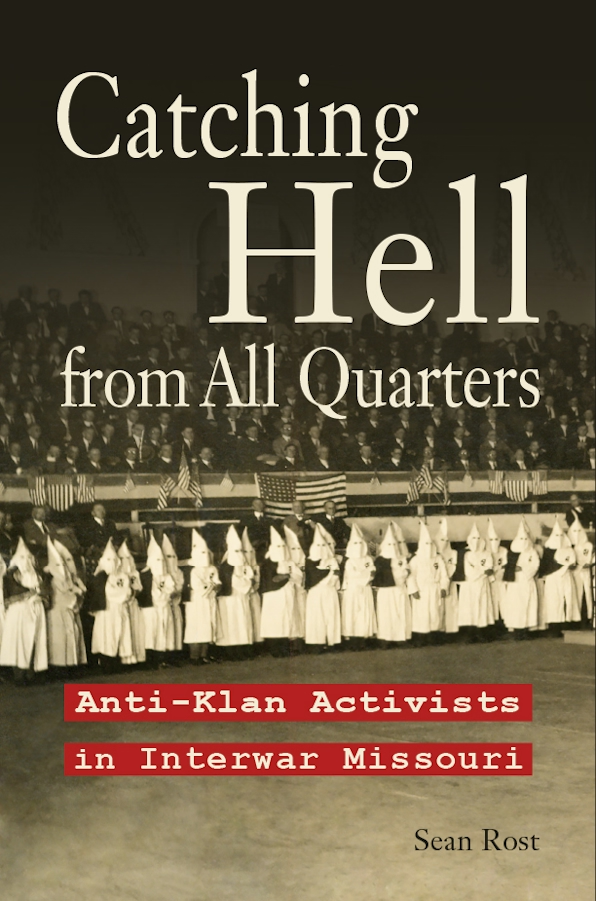 Sean Rost, Catching Hell from All Quarters: Anti-Klan Activists in Interwar Missouri (University of Missouri Press)
[Rost] works to invert the traditional history of what has been termed the second Ku Klux Klan (1915-1930) by examining the efforts of anti-Klan activists, in particular in Missouri, who challenged the growth, recruitment, and political ambitions of the Invisible Empire during the 1920s and 1930s through editorial crusades, educational campaigns, public pressure on elected officials, political investigations, and in some cases counter-vigilantism.
 Alejandro Salamanca Rodríguez, A Microhistory of Early Modern Transatlantic Migration: The Frigate Agata (1747) (Routledge)
Through a microscopical lens, this book delves into the lives of some of the migrants linked to the Agata, either as members of the crew —a ship, after all, is a moving workplace— as passengers, or as people sending letters through the ship. Their stories and anecdotes illustrate how early modern migrants in the Spanish Atlantic navigated the often-restrictive migration laws, stayed connected with family and friends back home, sent remittances and gifts, and built networks to support new migrants.
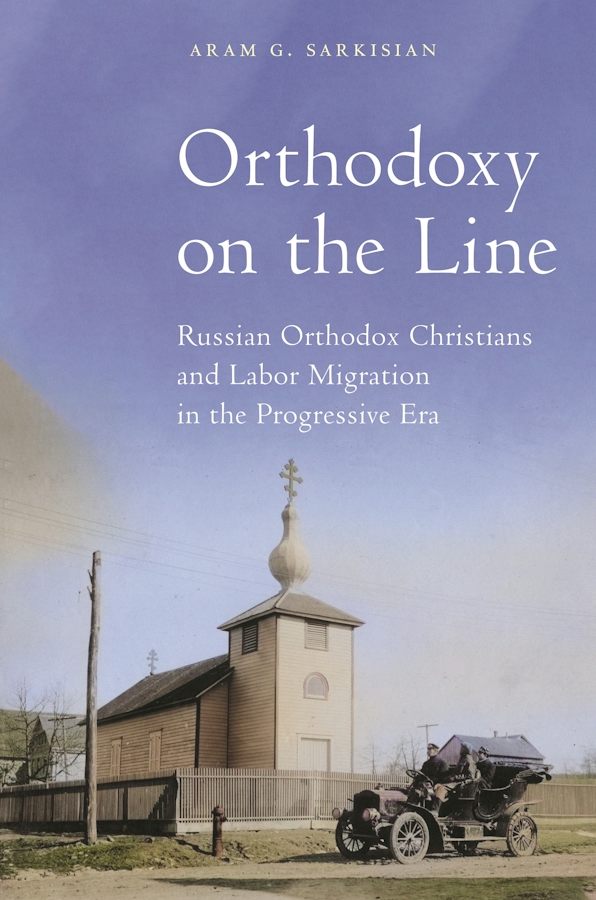 Aram Sarkisian, Orthodoxy on the Line: Russian Orthodox Christians and Labor Migration in the Progressive Era (New York University Press)
The work Russian Orthodox immigrants did in the Progressive Era United States occurred in factories, foundries, and mines . . . To address their needs in these contexts, the Russian Orthodox Church [formed] a network of social and material aid for working-class believers. This book traces the rapid growth of this transnational religious world, then explores its unexpected collapse under the weight of the First World War, a global pandemic, and the transnational reach of revolutionary political change.
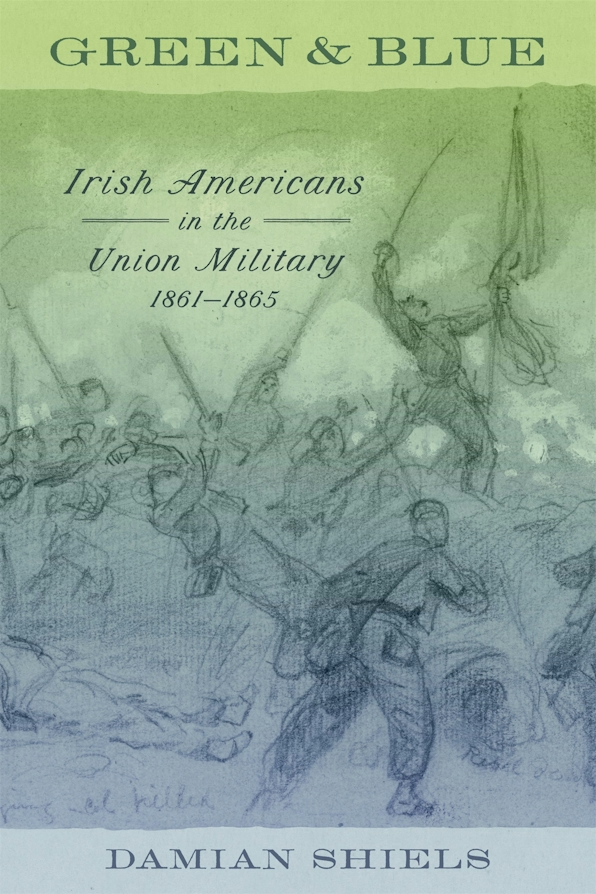 Damian Shiels, Green & Blue: Irish Americans in the Union Military, 1861-1865 (Louisiana State University Press)
Using a vast and largely untapped collection of letters penned by Irish American combatants to their families during the war, Shiels explains how these enlisted men navigated their duties from multiple perspectives, including how they adapted to and experienced military life, how they engaged with their faith, and how they interacted with the home front. Green and Blue offers the most detailed and intimate picture yet of Irish Americans’ service in the United States military during the Civil War.
 Alicia Spencer-Hall, Stephanie Grace-Petinos, and Leah Pope Parker, eds. Disability and Sanctity in the Middle Ages (Amsterdam University Press)
This volume significantly expands current understandings of both disability and sanctity in the Middle Ages . . . The collection is a powerful rebuttal to the notion of the integral relationship of disability—medieval and otherwise—with sin, stigma, and shame. So doing, it recentres medieval disability history as a lived history that merits exploration and celebration. In this way, the volume serves to reclaim sanctity in disability histories as a means to affirm the possibility of radical disability futures.
 Alison Terndrup, Image of the Modern Ottoman Sultan: Visibility, Identity, and Modernity in the Nineteenth Century (Brill)
Over the course of the dynamic nineteenth century, the image of the Ottoman sultan maintained a complex relationship with ideas surrounding the modernisation of the Empire. This book investigates that relationship by situating the taṣvīr-i hümāyūn (imperial portrait) within the wider program of top-down modernisation movements initiated at the end of the eighteenth century under Sultan Selim III and culminating in the Tanẓīmāt (Reorganization) era.
 Mikko Toivanen, Empire, Tourism, and Colonial Knowledge in Nineteenth-Century Southeast Asia and Sri Lanka (Leiden University Press)
This book provides a fresh reinterpretation of the global spread of modern leisure travel in the middle of the nineteenth century through a critical comparative reading of twenty-two works of popular travel writing from maritime Southeast Asia and Ceylon. The examination of these books reveals a coherent genre that . . . served to legitimise colonial rule and codify aspects of colonial culture in the popular metropolitan imagination.
 Ciaran Wallace, Meath: the Irish Revolution 1912-23 (Four Courts Press)
Stretching from Ulster to Dublin, Meath encompasses a variety of farming landscapes and local economies. During these revolutionary years residents of Oldcastle, Gormanstown and Enfield saw very different patterns of politics and fighting. At the same time, across the county a social and technological revolution brought exciting new opportunities, especially for women. But older agrarian tensions simmered below the surface. [This] book tells the story of the Irish Revolution in Meath, keeping the people’s daily experience always in focus.
 Oscar Winberg, Archie Bunker for President: How One Television Show Remade American Politics (University of North Carolina Press)
Delving into the intersection of television entertainment and American politics during the 1970s, focusing on the sitcom All in the Family, this book explores how political campaigns, social movements, and legislators leveraged the show’s popularity for their own agendas. [This] multifaceted history expands the discussion on the interconnected roles of media and politics, offering a new exploration into how one television show produced a profound cultural shift in American politics.